
 You don’t need to know exactly where you’re going to start moving

If you have worked through Take Stock and Recognise What You Bring, you have already done something important, you have resisted the temptation to begin with the job search.
Instead, you have spent some time understanding where you are, what matters to you and what you would like to take forward. You have looked beneath your employment history and begun recognising the capabilities, knowledge, experience and qualities you have accumulated along the way.
Perhaps that has confirmed what you already knew, perhaps it has reminded you of things you had forgotten, perhaps, somewhere during Recognise What You Bring, you began to think…I could use this somewhere else.
That’s where we want to begin, not with a vacancy, not with a CV, and not with the pressure to decide what you are going to do for the rest of your working life. We want to begin with possibility, because knowing what you bring is useful, beginning to understand where you might take it is where things start to move forward.
Using Prepare to Move Forward
This chapter is accompanied by My Prime Candidate Workbook | 03 Prepare to Move Forward.
We suggest keeping it open as you work through the chapter. The chapter will help you explore possibilities, think about what would work for you, investigate ideas and gradually begin turning those ideas into direction. Your Workbook is where you can capture that thinking.
Download My Prepare to Move Forward Workbook →
There is no expectation that you should know exactly what you want to do before you begin, quite the opposite. At this stage, “I’m interested in finding out more” can be a perfectly useful answer.
The purpose isn’t to make a premature career decision, it’s to move from wondering what might be possible towards understanding which possibilities are worth exploring.
01 | KEEP THE POSSIBILITIES OPEN
 Don’t make your world smaller too quickly
At the end of Recognise What You Bring, we asked you to consider a different question. Not simply, what jobs can I apply for? but where could someone like me add value? There is an important difference between those questions. The first can send you immediately towards vacancies, the second encourages you to explore.
Imagine someone whose most recent job was Customer Service Manager, searching that job title online may produce hundreds of vacancies. Some may be very suitable, but the search has already made an assumption – The next thing I should do probably has the same name as the last thing I did.
Perhaps it does, but perhaps the person’s experience includes resolving difficult situations, developing people, interpreting customer information, improving processes, managing competing priorities, influencing colleagues and communicating complicated information clearly.
Where else might those capabilities be useful? That is a much bigger question, and at this stage, bigger can be useful. This doesn’t mean abandoning your previous occupation or deliberately searching for something completely different.
If you enjoyed your previous work and want to continue doing it, that is a perfectly valid direction. But let it be a choice rather than an assumption. One of the risks after a disruption in working life is that urgency begins to narrow our thinking. I need another job becomes, I need another job like the one I had, which then becomes, These are the only vacancies I can apply for.
Before long, the search can feel very small…Prime Candidate would like to keep the door open a little longer.
From your Workbook
Return to the final part of Recognise What You Bring…What possibilities occurred to you? Were there roles, sectors or types of organisation you hadn’t previously considered? Capture them without judging them yet. At this stage, an idea doesn’t need to be practical, available or even particularly well developed.
First explore. We can evaluate later.
02 | WHAT WOULD A GOOD NEXT MOVE LOOK LIKE?
 Being able to do a job doesn’t necessarily mean it is right for you
Job searches tend to focus heavily on one question, am I suitable for this job? That’s understandable, as employers describe what they need, candidates compare themselves against those requirements and decide whether to apply.
But there is another question that deserves equal attention, is this job suitable for me? Take Stock may already have given you some clues:
-
Perhaps you discovered that flexibility matters more to you than it once did, perhaps you want more responsibility, or less.
-
Perhaps you want to spend more time working with people.
-
Perhaps you have had enough of spending your working life in meetings.
-
Perhaps security matters.
-
Perhaps learning matters.
-
Perhaps salary is the overriding priority right now.
-
Perhaps you need work within a particular distance from home.
-
Perhaps you would welcome travel.
-
Perhaps you absolutely wouldn’t.
None of those answers is inherently better than another, as working lives sit inside lives, our circumstances, responsibilities, ambitions and priorities change. A role that was right for you ten years ago may not be right now. Equally, something you dismissed ten years ago might fit surprisingly well today. This is why Prepare to Move Forward isn’t simply about identifying what you can do.
We also need to consider what you want and need work to give you, there may be trade-offs. A fascinating role may pay less than you need, a highly paid role may involve travel you don’t want, a flexible job may offer less progression. A position that looks ideal on paper may belong to an organisation whose culture doesn’t feel right for you.
Very few jobs will satisfy every preference. The purpose isn’t to create an impossible specification for the perfect job, it’s to know enough about your priorities to recognise the difference between, something that looks like an opportunity and something that could actually work for you.
From your Workbook
Look back at My Take Stock, What did you say mattered to you? Now translate that thinking into your next move:
-
What do you need?
-
What would you strongly prefer?
-
What would simply be nice to have?
-
And are there things you already know you don’t want to repeat?
The clearer you become about those things, the more intelligently you can assess opportunities when they appear.
03 | TURN POSSIBILITY INTO INFORMATION
 You don’t have to decide whether an idea will work before you investigate it
Suppose something has emerged during this process that interests you, perhaps it’s:
-
A different role
-
A different sector
-
Self-employment
-
A smaller organisation
-
A larger one
-
A move into public service
-
A return to something you did earlier in your career
-
A role you didn’t previously know existed
The temptation can be to make a very quick judgement, I couldn’t do that, or, That sounds perfect. Neither conclusion is particularly useful without information. So instead of deciding, investigate:
-
What does the work actually involve?
-
What capabilities does it require?
-
What qualifications are genuinely necessary?
-
What are employers asking for?
-
What does somebody doing the work spend their day doing?
-
What is the salary range?
-
Where are the opportunities?
-
How do people usually enter the field?
-
What could progression look like?
The answers may confirm your interest, they may reduce it, both outcomes are useful. You might discover that something you assumed required years of retraining actually makes good use of capabilities you already possess. Or you may discover that an attractive-sounding role contains elements you would dislike doing every day, that isn’t failure.
You have replaced an assumption with information, and information helps you make better choices.
The National Careers Service, for example, provides role profiles covering typical tasks, routes into occupations, qualifications and progression. Resources like that can help with exploration, but don’t stop at a single description. Look at several real vacancies and, where possible, talk to people who know the work.
From your Workbook
Choose one or more possibilities that genuinely interest you, and for each one, investigate:
-
What does the work involve?
-
What does it require?
-
What do I already bring?
-
What might I need to develop?
-
What do I still need to find out?
You are not applying yet, you are learning.
04 | DON’T CONFUSE A GAP WITH A BARRIER
 “I haven’t done that” and “I couldn’t do that” are not the same thing
When people begin exploring different possibilities, they often encounter requirements they don’t currently meet:
-
Perhaps a role uses unfamiliar software.
-
Perhaps employers prefer a qualification you don’t have.
-
Perhaps you have never worked in that sector.
-
Perhaps your technical knowledge needs updating.
-
Perhaps you haven’t formally managed people even though you have supported and influenced them for years.
That gap is useful information, but be careful what you conclude from it, as there is a considerable difference between, I don’t have this yet, and therefore this opportunity isn’t for me, some gaps are genuine barriers.
You cannot simply decide that professional qualifications, licences, regulatory requirements or essential technical expertise don’t matter, they do, but other gaps may be much more manageable:
-
A short course
-
Some online learning
-
Work experience
-
Volunteering
-
A conversation
-
A piece of software you can learn
-
Knowledge that can be updated
-
An existing capability that you simply haven’t learnt to describe in the language of a different sector
Current careers guidance similarly points to short courses, volunteering, work experience and self-directed learning as ways of developing or demonstrating capabilities for a different direction.
The important thing is to understand what kind of gap you are looking at, then you can make an informed decision about whether you want to bridge it. This matters particularly when confidence has been knocked. A job description containing ten requirements can quickly become ten reasons not to apply. Try looking at it differently:
-
Which requirements can I already evidence?
-
Which are genuinely essential?
-
Which could I learn?
-
Which do I need to understand better?
-
And which might simply be written differently from the language I used in my previous work?
You are not trying to convince yourself that you can do anything, you are trying to avoid ruling yourself out before you have established what is actually possible.
From your Workbook
For one of the possibilities you are exploring, compare what it requires with what you identified in Recognise What You Bring. Create three groups:
-
I already bring this.
-
I could develop this.
-
I need to find out more about this.
Notice how different that feels from a simple list of things you don’t have.
05 | TEST THE IDEA BEFORE YOU COMMIT TO IT
 Exploration can be active without becoming a major decision
There is a tendency to think about career decisions as big moments:
-
I’m going to change career.
-
I’m going to retrain.
-
I’m going to work in a different sector.
Sometimes they are big decisions, but the thinking that leads to them can be made up of small experiments. If you are interested in an occupation, find somebody who does it and ask them about their work. If a sector interests you:
-
Follow some organisations within it
-
Attend an event.
-
Join an online discussion.
-
Watch a webinar.
-
Read industry publications.
-
Look at ten vacancies rather than one.
-
Try a short introductory course.
-
Volunteer if that gives you meaningful exposure to the work.
-
Ask somebody in your network whether they know someone you could speak to.
The National Careers Service also suggests talking to people about their jobs and using volunteering, work experience and learning to investigate or develop career possibilities.
None of these actions commits you to changing direction, they simply give you better evidence. Imagine you are considering moving into project management because several of the capabilities you identified seem relevant. You speak to two project managers, one works in technology, the other works in construction. Their jobs are quite different:
-
You discover aspects of the work that appeal to you and others that don’t.
-
You notice terminology you haven’t used before.
-
You identify a qualification employers frequently mention.
-
You also discover that you’ve been doing elements of project management for years without calling them that.
You haven’t changed career, but your understanding has changed considerably, that’s progress.
From your Workbook
Choose one possibility and decide how you could test it without committing to it.
-
Who could you speak to?
-
What could you read?
-
What could you observe?
-
What could you try?
-
What question do you most want answered?
Small experiments can turn a vague possibility into something much more useful, evidence.
06 | BUILD MORE THAN ONE DIRECTION
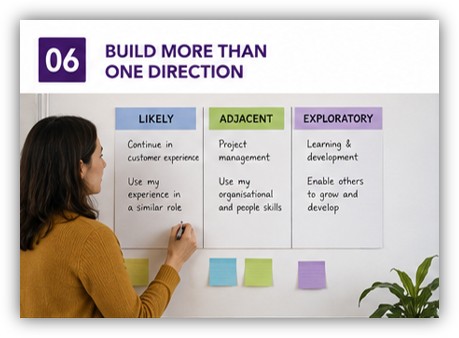 Your next move doesn’t have to be a single answer
By this point, you may have one direction that feels increasingly obvious, that’s useful, but you may also have several, and that’s useful too. Prime Candidate doesn’t think you necessarily need to reduce everything immediately to one target job title, instead, consider three possible horizons.
Your most likely next move
This may be closely connected to what you have already done, perhaps the same occupation in a different organisation, perhaps a similar role with different responsibilities, or perhaps work where your existing experience gives you an obvious advantage. There is nothing unambitious about that, sometimes the right next move is simply a better version of something you already know you can do.
Your adjacent possibility
This is where things become interesting. An adjacent possibility uses a significant amount of what you already bring but applies it differently:
-
A retail manager moves into customer experience.
-
An administrator moves into project co-ordination.
-
A teacher explores learning and development.
-
A salesperson considers partnerships or account management.
-
A technician explores training.
The precise possibilities will be different for everybody, the important idea is that a career doesn’t always move in a straight line, sometimes the most interesting opportunities sit one step to the side.
Your exploratory possibility
Then there may be something less obvious, something you are curious about, something that emerged when you asked, Where else could this be valuable? You may know very little about it yet, that’s fine, this isn’t your commitment, it’s your permission to investigate.
Having more than one horizon can also make a job search feel less trapped. Instead of waiting for one particular kind of vacancy to appear, you are beginning to recognise several places where your value might fit.
From your Workbook
Capture your three horizons:
-
My most likely next move
-
My adjacent possibility
-
My exploratory possibility
You don’t need all three, and they don’t carry equal weight, the purpose is simply to give your thinking enough structure to move forward without closing down possibilities too early.
07 | TURN DIRECTION INTO MOVEMENT
 Progress doesn’t require a perfect plan
Planning can become another way of standing still:
-
We research
-
We think
-
We make lists
-
We change the lists
-
We wait until we feel completely ready
Eventually, even useful reflection needs to become movement, but movement doesn’t need to be dramatic:
-
One conversation can be movement
-
One piece of research
-
One course enquiry
-
One newly discovered organisation
-
One person contacted
-
One role investigated properly
-
One assumption challenged
-
One decision made
The purpose of Prepare to Move Forward isn’t to leave you with a complicated action plan covering the next six months, it is to help you identify the next few things worth doing. Perhaps one action will confirm the direction you are considering, perhaps it will rule something out, again, both are progress.
The National Careers Service describes career planning in similar terms, explore options, identify routes, consider learning or experience where needed, and translate longer-term aims into shorter-term actions.
Prime Candidate would add something else, your direction is allowed to change. New information may change it, a conversation may change it, an opportunity you didn’t know existed may change it, your circumstances may change it, a plan is there to help you move, it isn’t there to trap you.
From your Workbook
Choose three actions.
-
Something I will investigate.
-
Someone I will speak to.
-
Something I will do.
Make them small enough to begin, then begin.
MY DIRECTION
Bring the picture together
You began Prime Candidate by taking stock, you thought about where you are, what has changed, what matters and what you want to carry forward. Then you looked more closely at what you bring:
-
Your capabilities
-
Your experience
-
Your knowledge
-
Your evidence
-
The things other people value in you
-
And the things that might travel further than your previous job title
Now you have started looking outwards:
-
You have considered possibilities
-
You have thought about what a good next move would need to give you
-
You have investigated what interesting directions actually require
-
You have separated genuine barriers from things you could potentially learn or develop
-
And you have begun turning possibilities into actions
You may still not know exactly where you are going, that’s all right, there is a significant difference between, I don’t know what to do, and, I have several directions worth exploring. Prepare to Move Forward is about helping you make that shift.
From your Workbook
Complete My Direction, capture:
-
What I know I want from my next move
-
The direction that currently feels strongest
-
An adjacent possibility worth exploring
-
Something I’m curious about
-
What I already bring to those possibilities
-
What I may need to develop or investigate
-
My next three actions
Keep this summary with My Take Stock and My I Bring…together, the three tell an increasingly useful story:
-
Where I am
-
What I bring
-
Where I might take it
Where does this leave you?
There is something we have deliberately not done yet, we haven’t written your CV, we haven’t drafted an application, we haven’t practised interview answers, and we haven’t asked you to apply for dozens of jobs. That has been deliberate. Before presenting yourself to the employment market, Prime Candidate wanted you to have something more useful than a polished document, a clearer understanding of yourself:
-
You know more about where you are.
-
You can see more of what you bring.
-
And you are beginning to develop a direction.
Now we can start thinking about how you present that value to somebody else. Not by squeezing your working life back into the narrow labels we have just worked so hard to look beyond, but by learning how to communicate the experience, evidence and value you have uncovered…that is where we go next.
A Prime Candidate thought
You don’t need the whole route mapped out before you move, you need a direction, and a useful next step.
CONTINUE | TELL YOUR STORY – Communicate your value.

TELL YOUR STORY
You know more about what you bring, now you need to help someone else see it.
By this point, you’ve done quite a lot of thinking. You’ve taken stock of where you are, you’ve looked beyond job titles and started to recognise the experience, capabilities and evidence you’ve accumulated. You’ve explored where those things might take you and begun to identify some possible directions.
That work matters, but eventually something changes. Until now, most of the conversation has been with yourself, the next part is about helping someone else understand what you’ve discovered.
That might be an employer reading your CV, a recruiter looking at your profile, someone you’ve met through your network, a person considering your application, or simply someone who asks, “So, what are you looking to do next?”
For many people, that’s where things suddenly become difficult. You can know that you have years of experience and still struggle to explain why it matters, you can have achieved a great deal and find yourself staring at a blank page when asked to write about yourself. You can know exactly what you’ve done, but not yet know how to make it relevant to someone who doesn’t know you.
That’s what we’re going to work on next, not by inventing a new version of you, but by learning to tell the story of the person who is already there.
Using Tell Your Story
This chapter is accompanied by My Prime Candidate Workbook | 04 Tell Your Story.
We suggest keeping it open as you work through the chapter. The chapter will help you think about what you want someone else to understand about you, identify the evidence behind what you bring, translate your experience into language others can recognise, and begin shaping a story that feels relevant, credible and genuinely yours. Your Workbook is where you can capture and develop that thinking.
Download My Tell Your Story Workbook →
There is no expectation that you should already know exactly how to describe yourself. In fact, that’s one of the reasons for doing this work. “I know what I’ve done, but I’m not sure how to explain what I bring” is a perfectly good place to begin.
The purpose isn’t to create a polished sales pitch or find impressive words to describe yourself. It’s to help you turn what you’ve already discovered about your experience, capabilities and direction into a story that another person can understand.
By the end, you’ll have created My Story, something you can return to and adapt when you begin working on your CV, profile, applications, networking conversations and interviews.
01 | YOUR EMPLOYMENT HISTORY ISN’T YOUR WHOLE STORY
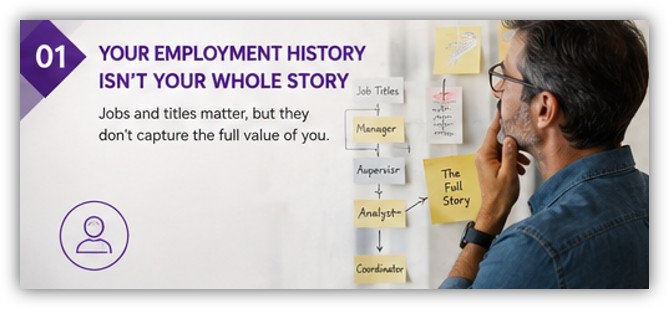 Most CVs begin with chronology, where did you work? What was your job title? When were you there? What were your responsibilities? Those things matter as employers need to understand your employment history.
But they don’t necessarily explain you.
A job title is a label created for a particular role in a particular organisation at a particular point in time. Sometimes it describes what someone actually did reasonably well, sometimes it barely scratches the surface.
Two people can hold the same job title and have completely different experiences. One may have spent years solving complex customer problems, another may have become the person colleagues relied upon when something went wrong. Someone else may have developed people, introduced new processes, managed difficult relationships, worked through periods of enormous change or quietly kept an operation functioning when circumstances were difficult. The job title might be identical, the story isn’t.
That’s why Prime Candidate has deliberately asked you to explore your experience before asking you to write a CV. If we’d started with the CV, there’s a good chance you would simply have described the jobs you’ve already had, now we can do something different. We can begin with, what do I want someone to understand about me?
FROM YOUR WORKBOOK
Look back at My I Bring… and My Direction.
Don’t rewrite anything yet, but notice the words, experiences, capabilities and examples that keep appearing. Which of them feel most important to the story you want to tell now?
02 | START WITH WHAT YOU WANT THEM TO UNDERSTAND
 Imagine meeting someone who knows nothing about your working life. You have a few minutes together, you could tell them every job you’ve ever held, you could list qualifications, you could describe your responsibilities, but what would you actually want them to remember?
Perhaps it’s that you’re particularly good at bringing order to complicated situations, perhaps you’ve spent much of your career helping customers. Maybe you develop people, perhaps you’re at your best when solving practical problems, building relationships, improving things, analysing information, creating ideas or getting something over the line.
Maybe the strongest thread through your working life isn’t a particular occupation at all. This is where we begin moving from employment history to professional story. And that doesn’t mean producing a clever slogan, it means finding the thread:
-
Think about the things people repeatedly trusted you to do.
-
Think about the problems you were asked to solve.
-
Think about the situations in which you were particularly effective.
-
Think about what you’ve learnt through experience that somebody encountering your job titles alone would never know.
Your story begins there.
FROM YOUR WORKBOOK
Try completing this sentence without worrying about making it sound polished…
If someone only remembered three things about what I bring, I’d want them to remember…
Write naturally, we’ll work on the language later.
03 | MOVE FROM CLAIMS TO EVIDENCE
 It’s very easy to describe ourselves using familiar words:
-
Experienced
-
Adaptable
-
Organised
-
Reliable
-
Strategic
-
Creative
-
Good with people
There’s nothing necessarily wrong with any of them, the problem is that thousands of other people can say exactly the same thing. What makes your story convincing isn’t the claim, it’s the evidence behind it.
If you say you’re adaptable, when did you have to adapt? If you’re good at building relationships, which relationships have you built and why did they matter? If you’re organised, what have you organised? If you’re good at solving problems, what sort of problems? If you lead people well, what happened because of that leadership?
This is one reason the work you’ve already done matters so much. In Recognise What You Bring, we asked you to notice what may have become normal to you. We looked at experience as evidence rather than simply history.
Now we’re going to use that evidence, instead of, “I’m an experienced manager with excellent communication skills.” you might discover something more revealing, “Much of my experience has involved bringing people together when priorities are competing and helping teams find a practical way forward.”
That sentence gives us something to explore…What people? What competing priorities? What happened? Suddenly we have the beginnings of a story rather than a collection of adjectives.
You don’t have to tell someone you’re capable if you can help them see the evidence for themselves.
FROM YOUR WORKBOOK
Choose three things you believe you bring, and for each one, ask, What makes me say that?
Then find an example. The example doesn’t have to be spectacular, it has to be real.
04 | TRANSLATE YOUR EXPERIENCE. DON’T INFLATE IT.
 Changing direction can create an unusual problem, you may have exactly the kind of experience another organisation needs, but neither of you immediately recognises it because you’re using different language.
Different industries describe similar activities differently. Job titles vary between organisations, terminology changes, technologies change, and ways of working evolve. That can make valuable experience appear less transferable than it really is.
Suppose you’ve spent years coordinating people, deadlines, suppliers and resources to make sure something was delivered successfully. You may never have held the title Project Manager. That doesn’t mean your experience of coordinating complex work suddenly disappears. Equally, it doesn’t mean you should simply call yourself a Project Manager if that isn’t what you were.
The skill is in translation rather than inflation. You might say, “My role involved coordinating people, resources and deadlines across several areas to ensure projects were delivered on time.” That’s useful, it’s also true, and truth matters.
Your aim isn’t to make your experience sound bigger than it was, it’s to make its relevance easier to recognise. This becomes particularly important when you’re moving between sectors, returning after time away, considering a different kind of role or trying to explain experience that doesn’t fit neatly into conventional job titles.
Don’t ask, “How can I make this sound impressive?” ask, “How can I make this understandable and relevant?” That’s a much better question.
FROM YOUR WORKBOOK
Choose something from your previous experience that might be described differently in the direction you’re now exploring. Write it first in the language you’ve always used. Then try writing it again so that somebody outside your previous organisation or sector could understand the capability involved.
Don’t exaggerate it, translate it.
05 | RELEVANCE CHANGES WITH THE AUDIENCE
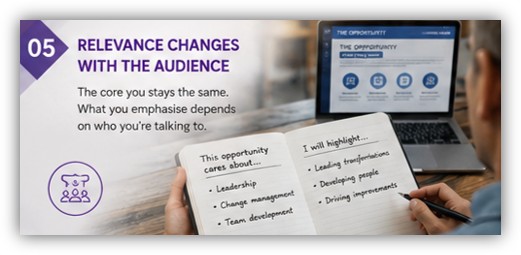 Your story belongs to you, but you don’t have to tell all of it every time. Imagine you’ve accumulated twenty or thirty years of working experience. It would be impossible to communicate every useful thing you’ve done in a two-page CV, nor would somebody reading it necessarily want you to. The question isn’t, “How do I fit everything in?” it’s “What matters here?”
A particular piece of experience might be highly relevant to one opportunity and almost irrelevant to another. One employer may be interested in your leadership experience, another may value your technical knowledge. A smaller organisation may be particularly interested in your ability to work across boundaries, whereas a role in a different sector may make your transferable capabilities much more important than your industry knowledge. None of that means you’re changing your story to suit the audience, you’re deciding which parts of your story are most useful for them to hear.
Think of a conversation with someone you know well. You don’t tell every person you meet everything about yourself, you naturally emphasise different things depending on the conversation. Professional communication works in much the same way, the core person remains the same, the emphasis changes.
FROM YOUR WORKBOOK
Choose one of the directions from My Direction.
Imagine an organisation in that area is considering you…ask, “What would they most need to understand about me?” Then, “Which parts of my experience provide the strongest evidence?”
You’re beginning to tailor your story.
06 | SOUND LIKE A PERSON
 Professional language can do something rather strange to us. People who are interesting, experienced and perfectly capable of holding a natural conversation suddenly begin writing things like, “Results-driven professional with a proven track record of delivering strategic outcomes within fast-paced environments.”
Perhaps that’s true, but it’s difficult to see the person behind it. The temptation is understandable, when something matters, we often try to make ourselves sound more professional. But professional doesn’t have to mean impersonal, and credibility rarely comes from using the most impressive words available, it comes from clarity, relevance and evidence.
Compare “Results-driven professional with excellent stakeholder-management capabilities.” With “I’ve spent much of my career working with people who have different priorities and finding ways to move things forward.”
The second may not sound as grand, but it gives someone something to understand. And if that’s genuinely what you’ve done, it gives you something you can talk about naturally when the conversation continues. That’s important, because the story on your CV shouldn’t be a version of you that disappears when you walk into an interview.
It should sound like you on a good day, clear, considered and able to explain the value of your experience.
FROM YOUR WORKBOOK
Read something you’ve previously written about yourself, perhaps an old CV profile, LinkedIn summary or application. Ask…Would I actually say this to another person?
If not, try saying it again in your own words, you may be surprised how much stronger it becomes.
BRINGING YOUR STORY TOGETHER
You don’t need a perfect paragraph, you don’t need a personal brand, and you certainly don’t need to reduce your entire working life to a catchy sentence. What you need is a clearer understanding of the story you want someone else to see.
Try bringing together four things:
-
I AM… How would I describe myself professionally now, without relying entirely on my previous job title?
-
I BRING… Which capabilities, experience, knowledge and qualities are most relevant to where I might go next?
-
I CAN SHOW THIS THROUGH… What evidence makes those claims credible?
-
I’M LOOKING TOWARDS… What kind of contribution, environment or opportunity am I now interested in exploring?
Don’t worry if your answers still feel rough, they should. This isn’t advertising copy, it’s your raw material, and raw material can be shaped.
MY STORY
By now, you have accumulated something much more useful than an updated employment history.
You have:
-
MY TAKE STOCK – Where I am.
-
MY I BRING… – What I have to offer.
-
MY DIRECTION – Where I might take it.
And now:
-
MY STORY – How I explain it.
Keep these together, because the next time you work on a CV, write an application, update a profile, contact somebody in your network or prepare for a conversation with an employer, you won’t have to begin with a blank page.
You’ll have something much better to begin with…You.
YOUR STORY CAN TRAVEL
One of the most useful things about doing this work first is that My Story isn’t a document, it’s the thinking behind several documents and conversations.
You can use it when writing your CV, you can draw from it when creating or updating an online profile. It can help you write an application or covering message, it can help you introduce yourself to somebody in your network.
And eventually it can help you answer one of the most deceptively difficult interview questions, “Tell me about yourself.” The format changes, the audience changes, the emphasis changes, but the foundations remain.
You know more about where you are, you recognise more of what you bring, you’ve begun exploring where you might take it, and now you’re learning how to help somebody else see it too.
PRIME CANDIDATE THOUGHT
Your story isn’t simply where you’ve worked. It’s what you’ve learnt, contributed and become capable of along the way, and where you might take that next.

Ready for the next step?
You now have the beginnings of three personal resources:
-
MY TAKE STOCK – Where I am.
-
MY I BRING… – What I have to offer.
-
MY DIRECTION – Where I might take it.